A deep return is better than a shallow one. A return to a corner is better than one down the middle. There’s no doubt that return placement matters, but how long does it matter?
With every shot after the return, it is logical that the effect of the return would decay. A strong return might not go for a winner, but it probably induces a weak reply, making it more likely that the returner can end the point on her next shot. But if she doesn’t, if the rally continues to 6, 10, or more shots, at some point the quality of that return is no longer a factor. Either she sacrificed the advantage it gave her, or her opponent defied the odds to get back on neutral (or better) terms.
You guessed it: We can quantify this.
Drawing on the thousands of 2020s matches logged by the Match Charting Project, let’s start with the simplest comparison: serves that landed beyond the service line versus those that landed in the service box. Deeper is unquestionably better: For men, a back-half return means winning the point 50% of the time, while an in-the-box return is good for only 41.4%. Even controlling for match (opponent, surface, etc), the difference is 7.7 percentage points.
Most of that advantage shows up in just a few shots after the return. These plots show the percentage-point advantage of a deeper serve at each stage of a rally:
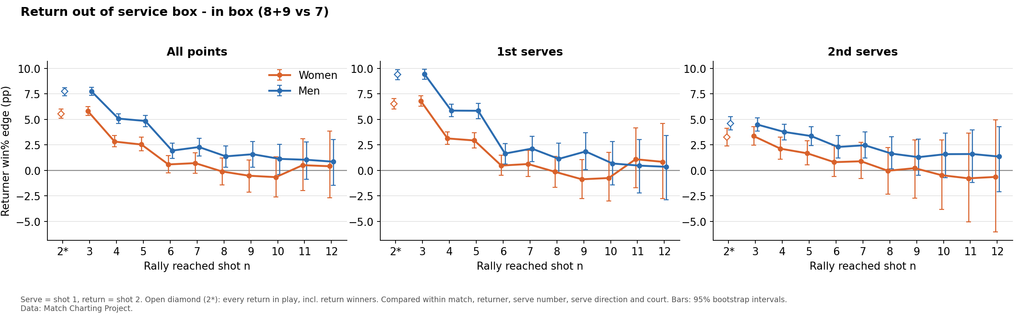
Return depth matters more, and for longer, in the men’s game. A back-half return against a first serve is worth about 2.5 percentage points more to men than to women. Against first and second serves, return depth plays a role up to at least the eighth shot.
For women, this basic measure of return depth loses half of its predictive power once the rally reaches its fourth shot. By then, the server has either capitalized and ended the point, or she has squandered her advantage. (Or the return was good enough that she didn’t have an advantage to squander.) By the sixth shot the return is barely a factor at all: The confidence interval says the effect could be zero.
The server’s natural control of the point also explains the stair-step nature of the graph. A big part of the difference between return influence on 3-shot rallies and 4-shot rallies is that the points with the weakest returns become third-shot (plus-one) winners. There is no fourth shot. The effect is similar, if smaller, between the 5th and 6th shots as well, in some of the plots.
What about angles?
An ideal return forces the server to move away from the middle of the baseline. Intuitively, it seems like line-kissing returns affect the development of a point differently than deep ones do. To overgeneralize: If the server has to move, he could immediately be at a disadvantage. A deep serve, by contrast, merely stops him from putting the point away.
The next set of plots show the difference between down-the-middle returns and crosscourt returns. (That is, crosscourt to the ~third of the court closest to the opposite sideline.) For men, the difference between crosscourt and middle isn’t as great as the gap between back-half and front-half. For women, it’s about the same. The return still remains a factor until the sixth or seventh shot:
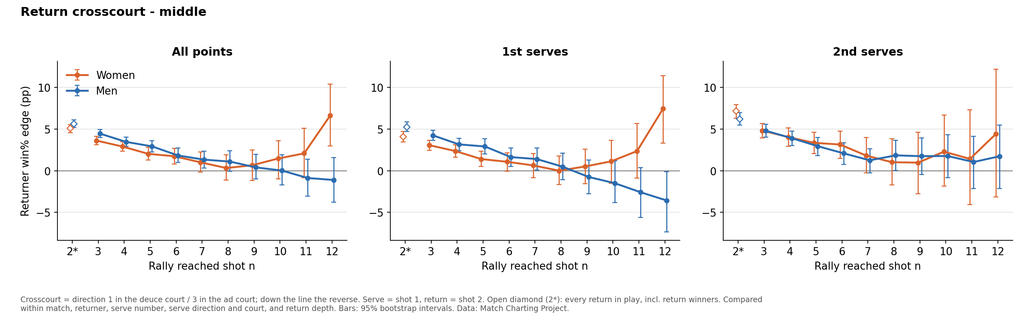
(Ignore the women’s trend lines that head back upward for long rallies. That might be a selection effect. Maybe returners who neutralize the server’s advantage are more likely to come out ahead in marathon points.)
Down-the-line returns are a little different. The biggest effect of hitting in that direction is an increase in service winners: In the next set of plots, check out the diamonds in the 2* column for second serves. That column includes all non-ace points; the other data points on the graph depend on the server putting a second ball in play:
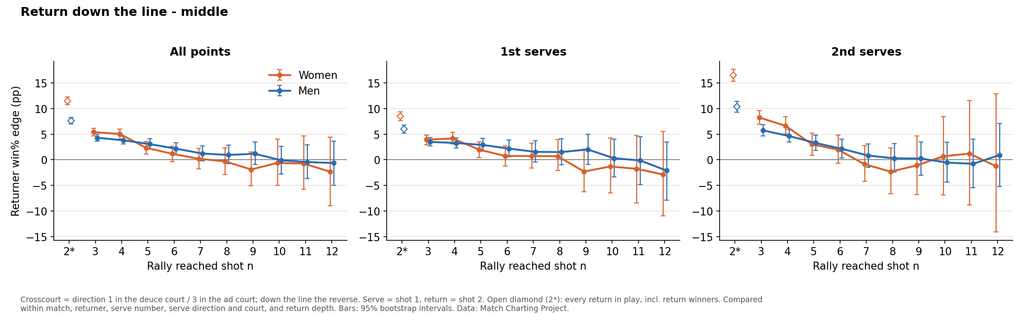
I expected that crosscourt returns would both be better than down-the-line returns and have a longer-lasting influence. I was wrong about the first. All else equal, down-the-line returns are a bit more effective, assuming they land in. Maybe servers expect a crosscourt return and lean that way. There’s a stronger case for the second. The advantage of a down-the-line return is gone for women by the sixth shot of the rally, the seventh shot for men.
Finding the backhand
Often, the returner’s goal isn’t to hit a particular corner, it is to target the server’s weaker side. For men, especially, that side is usually the backhand. Maybe there’s a detectable advantage–and ensuing influence–in finding the server’s backhand?
The evidence says: Not really. On men’s first serves, a little bit, and it’s gone after another stroke or two. The plots tell the story:
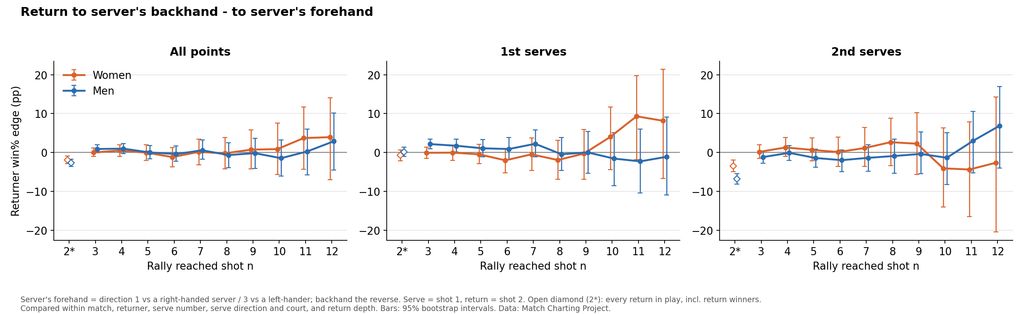
Of course, tennis is complicated and these are descriptive statistics, not recommendations. Returners have to weigh several factors (assuming they have time to think at all), not just which wing to target. If men tried to hit more returns to the backhand side, they’d have to do so with opportunities that aren’t as well-suited to a return in that direction, and that next marginal percentage point of returns-to-the-backhand might not be as good. In that sense, seeing near-equal outcomes for returns to either wing suggests that returners have found a reasonable, if not quite optimal, balance.
What about the extremes?
So far, we’ve been looking at one variable at a time. What’s the difference between a really well-placed return and a poor one? To put it another way, how much does return location matter at the extremes, and how long does the difference persist?
We can measure that by comparing “shallow-middle” (service box, middle third of the court) with “deep-corner” (back quarter of the court, outer thirds of the court) returns. The difference is substantial–nearly 20 points of win percentage for men on both first and second serves–but it doesn’t last much, if any, longer than the other effects we’ve seen:
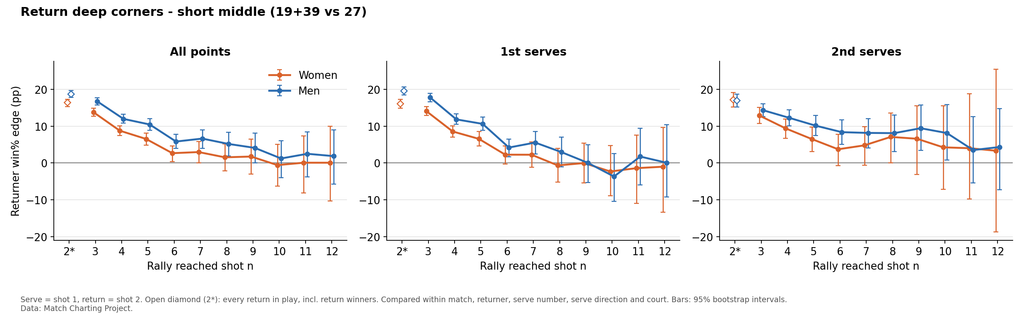
For women, the advantage of a very well-placed return is almost entirely gone before the sixth shot of the rally. It lasts longer for men, with the confidence interval touching zero only on the ninth shot. Still, both server and return have just a short window in which to capitalize on a weak or strong return.
Putting it all together: A good or bad return affects the development of the rally even after more shots have been struck. But not forever: If somebody tells you that a return set up a winner on the 12th stroke of a rally, they’re overstating the case. A good service return can accomplish a lot, but its powers are not unlimited.